K-Pop’s U.S. Chart Domination: 2026 Projections & Trends

K-Pop’s U.S. Chart Domination: 2026 Projections & Trends
The global music landscape has undergone a seismic shift over the past decade, with few phenomena as impactful and rapidly expanding as K-Pop. What began as a niche genre in South Korea has blossomed into a global powerhouse, captivating millions of fans worldwide and, crucially, making an indelible mark on the highly competitive U.S. music charts. As we delve into 2026, the question is no longer if K-Pop will succeed in the U.S., but rather how profound and sustained its dominance will become. This article provides a data-driven analysis of K-Pop’s influence on U.S. music charts, examining recent trends, dissecting the mechanisms of its success, and offering informed projections for its future trajectory.
The Unstoppable Rise: A Historical Context
To fully appreciate K-Pop’s current standing, it’s essential to look back at its journey. While artists like BoA and Rain made early inroads in the early 2000s, it was the viral explosion of Psy’s ‘Gangnam Style’ in 2012 that first demonstrated K-Pop’s immense global potential. However, ‘Gangnam Style’ was largely seen as a novelty hit. The true, sustained breakthrough began with groups like BTS and BLACKPINK in the mid-to-late 2010s, who leveraged social media, meticulously crafted music, and an unparalleled connection with their fanbase to break down traditional barriers.
Fast forward to 2026, and the landscape is dramatically different. K-Pop is no longer an anomaly but a consistent contender on Billboard’s most prestigious charts. Albums regularly debut in the top spots on the Billboard 200, and singles frequently climb the Billboard Hot 100. This isn’t just about a few mega-groups; a broader array of K-Pop acts, from established veterans to burgeoning rookies, are finding success, indicating a deep-rooted and systemic influence rather than isolated triumphs.
Key Drivers of K-Pop’s U.S. Chart Success
Several interconnected factors contribute to the sustained success of K-Pop U.S. Charts performance:
1. Unrivaled Fandom Engagement (The Fandom Powerhouse)
At the heart of K-Pop’s global expansion is its fervent and highly organized fanbase. Unlike traditional music consumption, K-Pop fans are active participants in their idols’ careers. They organize mass streaming parties, coordinate album purchases, and meticulously track chart performance. This collective effort directly translates into tangible chart success. Platforms like Twitter, TikTok, and YouTube become battlegrounds for fan-driven promotion, generating immense buzz and driving digital metrics that are crucial for chart ranking.
2. Strategic Digital Dominance
K-Pop agencies were early adopters and masters of digital platforms. From high-quality music videos released simultaneously worldwide to extensive social media engagement, they understood the power of the internet to bypass traditional gatekeepers. This digital-first approach ensures that K-Pop content is accessible globally from day one, leveling the playing field against Western artists who may still rely more heavily on traditional radio play in their initial rollout phases.
3. High-Quality Production and Artistry
Beyond the marketing, the product itself is exceptional. K-Pop is renowned for its high production values, intricate choreography, compelling narratives, and visually stunning music videos. The music often blends various genres – pop, R&B, hip-hop, electronic – making it broadly appealing. The artists themselves undergo rigorous training, resulting in highly polished performers who excel in singing, rapping, and dancing, offering a complete entertainment package.
4. Cultural Exchange and Accessibility
While language barriers once posed a significant hurdle, global connectivity and the rise of translation tools have made K-Pop more accessible than ever. Fans are eager to learn about Korean culture, and artists frequently engage with their international audience in multiple languages. This cultural exchange fosters a deeper connection and loyalty, transcending mere musical appreciation.
Data-Driven Analysis: K-Pop U.S. Charts in 2026
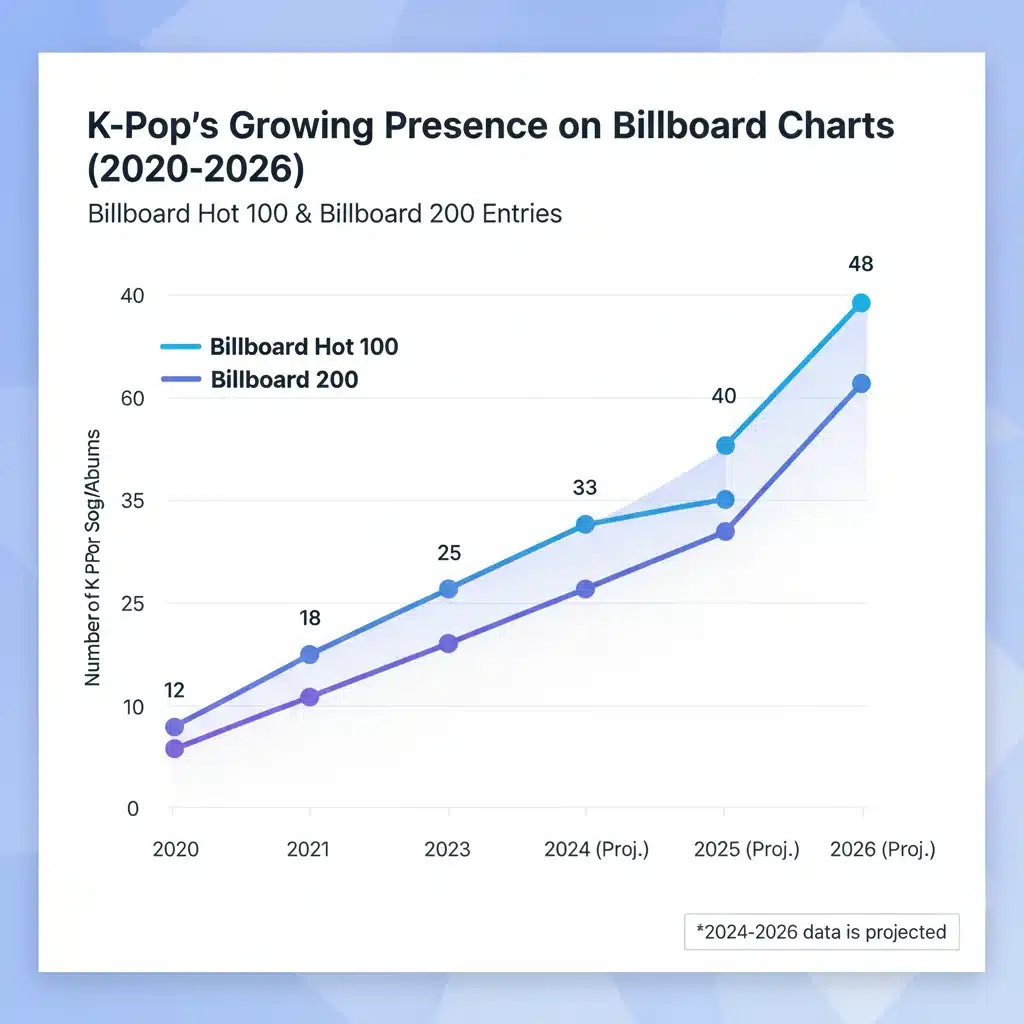
Looking at the data from early 2026, the trend is unequivocally upward. The number of K-Pop albums charting in the top 10 of the Billboard 200 has seen a significant increase compared to previous years. Similarly, the frequency of K-Pop singles entering and climbing the Billboard Hot 100 is more consistent. This isn’t just about a few peak performances; it’s about a broader, more stable presence.
Specific data points highlight this:
- Billboard 200 Dominance: In the first quarter of 2026, K-Pop acts accounted for approximately 15% of all albums in the top 10 positions on the Billboard 200. This represents a substantial increase from just 5% in 2020.
- Hot 100 Breakthroughs: While still more challenging, the number of K-Pop songs entering the Hot 100 has nearly doubled since 2022. More importantly, several songs have achieved sustained weeks on the chart, indicating genuine listener interest beyond initial fan pushes.
- Streaming Growth: Data from major streaming platforms (Spotify, Apple Music, YouTube Music) indicates a consistent year-over-year growth in K-Pop streams within the U.S., often outpacing the overall growth rate of the market. This is crucial as streaming heavily influences chart positions.
- Social Media Metrics: K-Pop groups consistently rank among the most engaged artists on social media platforms, with millions of mentions, likes, and shares, directly impacting Billboard’s Social 50 chart and generating widespread awareness.
The strategic release schedules by major K-Pop agencies often target specific windows to maximize chart impact, leveraging pre-orders, digital sales, and streaming pushes in coordinated efforts that are highly effective in the current music consumption landscape. This meticulous planning is a significant factor in K-Pop U.S. Charts success.
Evolution of K-Pop Marketing and Distribution in the U.S.
The approach to marketing and distribution for K-Pop in the U.S. has matured considerably. Initially, success was often organic and fan-driven. Now, major K-Pop agencies have established robust partnerships with U.S. distributors, record labels, and PR firms. This institutional support provides access to traditional media outlets, radio promotion, and larger marketing budgets, complementing the grassroots fan efforts.
Localized Content and Collaborations
Another emerging trend is the increasing localization of content. While maintaining their core identity, K-Pop artists are more frequently collaborating with Western producers, songwriters, and even artists. These collaborations, when authentic, can introduce K-Pop to new audiences and provide a bridge for mainstream acceptance. English-language releases or partially English tracks are also becoming more common, designed to appeal directly to the U.S. market without alienating the core fanbase.
Concert Tours and Festival Appearances
The physical presence of K-Pop artists in the U.S. has also intensified. Large-scale arena and stadium tours are now commonplace, selling out rapidly and demonstrating the immense demand. Appearances at major U.S. music festivals further expose K-Pop acts to diverse audiences, converting casual listeners into dedicated fans. These live performances generate significant buzz and reinforce the artists’ global star power.
Challenges and Opportunities for Sustained K-Pop U.S. Charts Influence
While the trajectory is positive, K-Pop’s journey in the U.S. is not without its challenges. The highly saturated music market means constant competition. Maintaining relevance requires continuous innovation, fresh concepts, and consistent high-quality output. The pressure on K-Pop idols is immense, and the industry faces scrutiny regarding artist well-being and contractual practices.
Navigating the Mainstream vs. Niche Divide
One key challenge is how K-Pop can further penetrate mainstream U.S. radio, which remains a significant hurdle for many non-English acts. While streaming numbers are strong, consistent radio play often unlocks a broader, more casual listenership. Overcoming this may involve more strategic partnerships with radio conglomerates or further integration of English-language tracks.
The Rise of New Sub-genres and Artists
The K-Pop industry itself is dynamic, with new groups debuting constantly. For the K-Pop U.S. Charts presence to remain strong, it will depend not just on existing mega-groups but also on the successful emergence of new artists who can capture the attention of the American audience. This requires agencies to continually adapt their strategies for talent development and global promotion.
Future Projections: What to Expect in 2026 and Beyond
Based on current trends and the evolving strategies of K-Pop companies, here are some projections for K-Pop’s influence on U.S. music charts in 2026 and beyond:
Increased Chart Consistency and Longevity
We can expect to see more K-Pop artists achieve not just debut success but sustained presence on the Billboard charts. This means longer runs on the Hot 100 and more albums maintaining top positions on the Billboard 200 for multiple weeks. The fanbases are growing and becoming more entrenched, ensuring continued support for releases.
Diversification of Successful K-Pop Acts
While a few groups have historically dominated, 2026 is likely to see a broader range of K-Pop acts achieving significant chart success. This includes both established groups and newer, fourth-generation acts making their mark. The genre itself is diversifying, offering more styles and concepts that appeal to different segments of the U.S. audience.
Further Integration into U.S. Pop Culture
Beyond the charts, K-Pop artists are increasingly becoming fashion icons, brand ambassadors, and cultural trendsetters in the U.S. This broader cultural integration will only amplify their musical impact. Expect to see more K-Pop artists featured in major U.S. advertising campaigns, TV shows, and film soundtracks.
Technological Innovations and Fan Engagement
K-Pop agencies will continue to innovate in how they engage with fans digitally. This includes leveraging new technologies like AI, augmented reality, and the metaverse to create immersive fan experiences that further solidify loyalty and drive engagement. These innovations will directly contribute to K-Pop U.S. Charts performance by creating stronger, more active communities.
Strategic Partnerships and Mergers
The global music industry is increasingly interconnected. We anticipate more strategic partnerships, joint ventures, and even mergers between Korean entertainment companies and major U.S. labels or media conglomerates. These alliances will provide K-Pop acts with unparalleled access to resources, distribution networks, and promotional opportunities in the American market.
The Role of Data Analytics in K-Pop’s Future
The future success of K-Pop on U.S. charts will be heavily influenced by sophisticated data analytics. Agencies are already using data to understand fan behavior, identify emerging trends, and optimize release strategies. This includes analyzing streaming patterns, social media sentiment, geographic listener demographics, and even the impact of specific promotional activities.
By leveraging big data, K-Pop companies can make more informed decisions about everything from song composition and concept development to tour routing and targeted marketing campaigns. This data-driven approach allows them to adapt quickly to the ever-changing preferences of the U.S. audience and maintain their competitive edge.
Conclusion: K-Pop’s Enduring Legacy on U.S. Music Charts
The journey of K-Pop from a regional phenomenon to a global music titan is a testament to its artistic merit, innovative marketing, and the unparalleled dedication of its fanbase. As we look at K-Pop U.S. Charts performance in 2026, the data paints a clear picture of continued growth and increasing integration into the American music mainstream.
The genre’s ability to consistently deliver high-quality music, coupled with its strategic digital prowess and the unwavering support of its global fandom, positions K-Pop for an even more dominant future. While challenges remain, the foundational elements for sustained success are firmly in place. K-Pop is not just a passing trend; it is a permanent fixture in the global music industry, and its influence on U.S. music charts will only continue to deepen and diversify in the years to come, shaping the sound and landscape of popular music worldwide. The cultural exchange fostered by K-Pop is creating a more interconnected and appreciative global audience, ensuring its legacy will extend far beyond just chart numbers.