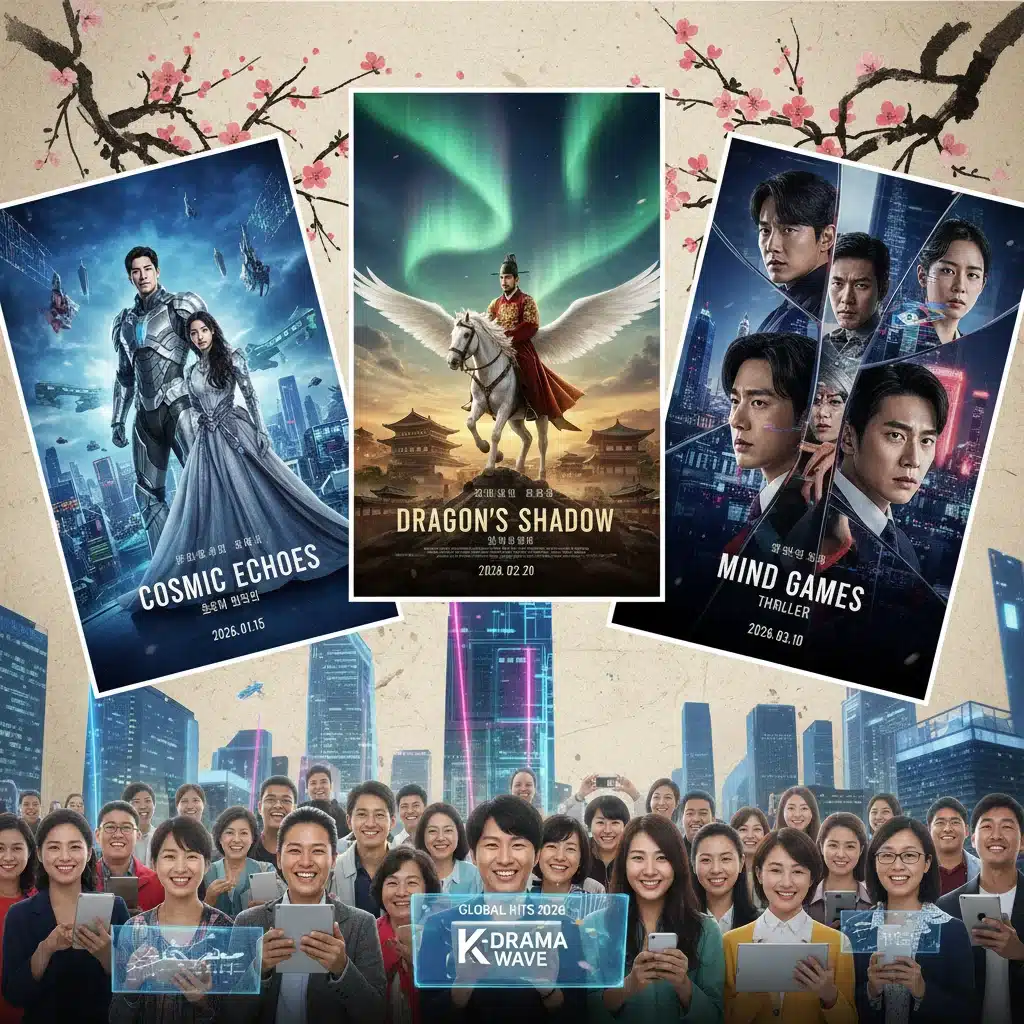
The landscape of global entertainment is ever-evolving, and at the forefront of this dynamic shift is the burgeoning influence of Korean dramas, affectionately known as K-Dramas. Long celebrated for their compelling narratives, intricate character development, and high production values, K-Dramas have transcended their regional popularity to become a global phenomenon. As we delve into early 2026, a new wave of releases is not just maintaining this momentum but actively engaging in a profound K-Drama genre redefinition, particularly for U.S. audiences. This article explores how three specific K-Dramas, launched in the initial months of 2026, are challenging traditional genre boundaries, introducing innovative storytelling techniques, and significantly impacting the viewing habits and cultural perceptions of American audiences.
The appeal of K-Dramas in the U.S. has been steadily climbing, fueled by accessibility through major streaming platforms and a growing appreciation for diverse narratives. However, what sets these 2026 releases apart is their audacious approach to genre. They are not merely fitting into existing categories; they are bending, blending, and sometimes outright breaking them to forge something entirely new. This K-Drama genre redefinition is a testament to the creative courage within the Korean entertainment industry, willing to experiment and push the artistic envelope.
Anúncios
In this comprehensive analysis, we will dissect the narrative structures, thematic explorations, and production innovations of these three pivotal series. We will examine how they are resonating with U.S. viewers, what cultural bridges they are building, and what implications their success holds for the future of international television. Prepare to embark on a journey through the cutting edge of Korean storytelling, where tradition meets innovation, and new genres are born.
Anúncios
The Shifting Sands of Storytelling: Why Genre Redefinition Matters
Before diving into the specifics of the 2026 releases, it’s crucial to understand why K-Drama genre redefinition is such a significant development. Genres traditionally serve as guiding principles for both creators and audiences, providing a framework of expectations. For creators, they offer a blueprint; for audiences, a promise of a certain type of experience. However, rigid adherence to genre can stifle creativity and lead to predictable narratives. The Korean entertainment industry, known for its rapid adaptation and innovation, has increasingly recognized the limitations of strict genre categorization.
The global streaming era has further accelerated this trend. U.S. audiences, in particular, have been exposed to an unprecedented variety of international content, fostering a palate for more complex, nuanced, and genre-bending stories. This exposure has created a fertile ground for K-Dramas that dare to defy easy classification. When a K-Drama successfully blends elements of romance with a gritty crime procedural, or infuses historical fantasy with sharp social commentary, it doesn’t just entertain; it challenges perceptions, expands horizons, and ultimately enriches the viewing experience.
This redefinition is not about abandoning genres entirely but rather about using them as starting points for creative exploration. It involves deconstructing tropes, subverting expectations, and weaving together disparate elements into a cohesive, yet strikingly original, tapestry. The result is often a more authentic and impactful narrative that resonates deeply with viewers who are hungry for something beyond the conventional. For U.S. audiences, this means a fresh perspective on storytelling, often imbued with unique cultural nuances that add layers of meaning not typically found in Western productions.
The success of this approach is evident in the critical acclaim and audience engagement these new K-Dramas are receiving. They are sparking conversations, driving cultural exchange, and demonstrating that innovative storytelling knows no geographical bounds. This movement is not just about entertainment; it’s about cultural dialogue and the universal appeal of human stories, told in new and exciting ways.
Case Study 1: ‘Chrono-Echoes’ – Blending Sci-Fi, Historical Drama, and Psychological Thriller
The first standout K-Drama of early 2026 that exemplifies K-Drama genre redefinition is ‘Chrono-Echoes’. This series boldly ventures into uncharted territory by seamlessly merging hard science fiction with intricate historical drama and the intense suspense of a psychological thriller. The premise is deceptively simple: a brilliant, yet troubled, quantum physicist from 2077 discovers a method to send his consciousness back in time to 1894 Joseon. His mission? To prevent a catastrophic future event by altering a seemingly minor historical detail. However, the past proves to be far more complex and resistant to change than anticipated, leading to unforeseen consequences and a descent into psychological torment.
What makes ‘Chrono-Echoes’ a masterclass in genre fusion is its refusal to prioritize one genre over the others. The sci-fi elements are meticulously researched and presented with stunning visual effects, making the temporal mechanics believable. The historical drama aspects are rich in period detail, offering a vivid portrayal of late Joseon society, its political intrigues, and cultural nuances. Crucially, the psychological thriller component is woven throughout, as the protagonist grapples with the ethical dilemmas of altering history, the existential dread of his isolated mission, and the creeping paranoia that his actions are creating more problems than they solve. The narrative cleverly uses the historical setting to amplify the psychological tension, as the protagonist’s modern sensibilities clash with the rigid social structures of the past.
U.S. audiences have been particularly drawn to ‘Chrono-Echoes’ due to its intellectual depth and emotional complexity. Unlike many Western sci-fi productions that often focus solely on spectacle, this K-Drama prioritizes character-driven storytelling and philosophical inquiry. Viewers are challenged to consider questions of fate versus free will, the impact of individual choices on grand historical narratives, and the psychological toll of bearing immense responsibility. The series has garnered praise for its ability to maintain a high level of suspense while also delivering profound emotional moments, a hallmark of excellent K-Drama genre redefinition.
The series’ success lies in its ability to cater to diverse viewer preferences simultaneously. Sci-fi enthusiasts appreciate the innovative time-travel mechanics, history buffs are captivated by the authentic period setting, and thriller aficionados are kept on the edge of their seats by the escalating psychological stakes. This multi-layered appeal has significantly broadened its reach within the U.S. market, proving that complex, genre-bending narratives can achieve mainstream success.
Case Study 2: ‘Crimson Bloom’ – A Dark Fantasy Romance with Social Commentary
The second groundbreaking K-Drama is ‘Crimson Bloom’, a series that takes the popular dark fantasy romance genre and injects it with sharp, incisive social commentary, thus driving further K-Drama genre redefinition. Set in an ethereal, yet dystopian, world where magic is both a blessing and a curse, the story follows a forbidden romance between a powerful, immortal being cursed with a bloodlust and a mortal woman fighting for justice in a society riddled with inequality. While the fantastical elements and romantic tension are undeniably central, ‘Crimson Bloom’ uses its supernatural premise to metaphorically explore contemporary social issues.
The series delves into themes of class struggle, systemic corruption, and the abuse of power, all under the guise of a captivating fantasy setting. The magical abilities of the immortal beings often serve as a metaphor for unchecked privilege, while the struggles of the mortal characters highlight the plight of the marginalized. The romance, rather than being a mere escapist fantasy, becomes a powerful vehicle for exploring empathy, sacrifice, and the possibility of change in a seemingly intractable world. The ‘dark’ aspect of the fantasy is not just aesthetic; it reflects the grim realities faced by the characters and the oppressive nature of their society.
U.S. viewers have responded enthusiastically to ‘Crimson Bloom’ because it offers more than just a visually stunning love story. It provides intellectual nourishment, prompting discussions about real-world societal problems through a fantastical lens. The series masterfully balances its romantic allure with its critical commentary, ensuring that neither element overshadows the other. This delicate balance is a hallmark of effective K-Drama genre redefinition, demonstrating that entertainment can also be thought-provoking.
The character development in ‘Crimson Bloom’ is particularly noteworthy. The immortal protagonist, initially portrayed as aloof and dangerous, undergoes significant transformation as he confronts his own prejudices and the injustices around him. The mortal heroine is not a damsel in distress but a fierce advocate for her people, driving much of the narrative’s social critique. Their evolving relationship is not just about personal connection but also about their collective fight against a flawed system, adding layers of depth rarely seen in traditional romance or fantasy dramas. This fusion of compelling romance with a strong social conscience makes ‘Crimson Bloom’ a truly unique and impactful viewing experience.
Case Study 3: ‘Silent Witness’ – The Neo-Noir Legal Thriller with a Supernatural Twist
The third K-Drama that is significantly contributing to K-Drama genre redefinition in early 2026 is ‘Silent Witness’. This series takes the established tropes of a legal thriller and neo-noir detective story and infuses them with a subtle, yet chilling, supernatural element. The plot revolves around a brilliant but disgraced lawyer who takes on seemingly unwinnable cases, only to discover that his inexplicable successes are tied to a unique ability: he can briefly perceive the ‘echoes’ of victims’ last moments, offering spectral clues that defy conventional investigation.
‘Silent Witness’ excels in creating a palpable atmosphere of suspense and moral ambiguity, characteristic of neo-noir. The visual style is dark and moody, with stark contrasts and shadows playing a significant role in conveying the psychological states of the characters. The legal battles are intense and meticulously crafted, showcasing the intricacies of the Korean justice system. However, it is the supernatural twist that elevates this series beyond a typical procedural. The lawyer’s ability is not a superpower for easy wins; it’s a curse that brings him closer to the trauma of the deceased, blurring the lines between justice and obsession, sanity and madness.
For U.S. audiences, ‘Silent Witness’ offers a refreshing take on the legal drama, a genre that can often become formulaic. The inclusion of a supernatural element, handled with subtlety and psychological depth rather than overt fantasy, adds a layer of intrigue and philosophical inquiry. Viewers are compelled to question the nature of truth, memory, and the unseen forces that might influence human events. The series doesn’t provide easy answers, instead opting for complex moral dilemmas and ambiguous resolutions, which resonates strongly with sophisticated audiences looking for more challenging narratives.
The character arc of the protagonist is particularly compelling, as he grapples with the ethical implications of using his ‘gift’ and the personal cost of constantly being exposed to the echoes of death. This internal struggle, combined with the external pressures of navigating a corrupt legal system, creates a rich narrative tapestry. ‘Silent Witness’ demonstrates that K-Drama genre redefinition can occur even within seemingly rigid frameworks like legal thrillers, by introducing an unexpected element that recontextualizes the entire narrative. Its success underscores the growing appetite for genre-blending stories that offer both intellectual stimulation and emotional impact.
The Impact on U.S. Audiences and the Future of K-Dramas
The collective success of ‘Chrono-Echoes’, ‘Crimson Bloom’, and ‘Silent Witness’ in early 2026 is not just a triumph for these individual series; it signifies a broader shift in how U.S. audiences engage with K-Dramas and, indeed, with international content in general. This wave of K-Drama genre redefinition is achieving several critical outcomes:
- Broadening Appeal: By blending genres, these K-Dramas are attracting viewers who might not typically gravitate towards traditional Korean romance or historical dramas. A sci-fi fan might discover ‘Chrono-Echoes’ and then explore other K-Dramas; a fantasy enthusiast might be drawn to ‘Crimson Bloom’ and then appreciate its social commentary.
- Elevating Perceptions: These sophisticated, genre-bending productions are further cementing K-Dramas’ reputation as high-quality, intellectually stimulating television, moving beyond any lingering stereotypes of being solely ‘fluffy’ or ‘niche’ content.
- Fostering Cultural Exchange: Through diverse narratives, U.S. audiences are gaining deeper insights into Korean culture, societal values, and historical contexts, even when presented through a genre-redefined lens. This promotes empathy and understanding across cultures.
- Influencing Western Productions: The innovative storytelling and production techniques seen in these K-Dramas are likely to inspire Western creators to experiment more with genre fusion and narrative complexity, potentially leading to a global cross-pollination of ideas.
- Driving Streaming Engagement: The critical acclaim and word-of-mouth buzz generated by these series are significant drivers for subscription growth and sustained engagement on streaming platforms, highlighting the commercial viability of genre innovation.
The future of K-Dramas in the U.S. looks brighter and more diverse than ever. This trend of K-Drama genre redefinition suggests a continued willingness to experiment, to push boundaries, and to tell stories that resonate on multiple levels. We can anticipate even more audacious genre fusions, more complex characters, and more profound thematic explorations. The traditional barriers between genres are crumbling, paving the way for a richer, more dynamic global entertainment landscape where Korean creativity continues to lead the charge.

The Role of Production Quality and Global Collaboration
It’s impossible to discuss the success of K-Drama genre redefinition without acknowledging the pivotal role of exceptional production quality and, increasingly, global collaboration. The three K-Dramas highlighted – ‘Chrono-Echoes’, ‘Crimson Bloom’, and ‘Silent Witness’ – all boast cinematic visuals, intricate sound design, and performances that are consistently lauded by critics and audiences alike. This commitment to high production standards is not merely about aesthetics; it’s about enhancing the storytelling, making the genre fusions believable, and creating an immersive experience for the viewer.
For ‘Chrono-Echoes’, the seamless integration of futuristic CGI with meticulously recreated historical sets requires significant investment and technical prowess. The visual language of the sci-fi elements must feel authentic, while the historical drama must transport the audience without jarring inconsistencies. This level of detail is crucial for making the genre blend cohesive rather than disjointed. Similarly, ‘Crimson Bloom’ relies on stunning costume design, elaborate set pieces for its fantastical world, and sophisticated special effects to bring its magical elements to life, all while maintaining the grittiness required for its social commentary. ‘Silent Witness’, though perhaps less reliant on overt spectacle, uses expert cinematography, lighting, and sound to build its neo-noir atmosphere and enhance the psychological tension, making the supernatural hints all the more impactful.
Beyond domestic talent, there’s a growing trend of international collaboration in K-Drama production. While not explicitly detailed for these specific 2026 releases, the industry as a whole is increasingly engaging with global VFX studios, sound engineers, and even writers and directors to bring diverse perspectives and cutting-edge techniques to their projects. This global outlook further refines the production quality and ensures that the narratives resonate with an international audience, facilitating the K-Drama genre redefinition on a global scale.
Streaming platforms play a crucial role here, not just as distributors but often as co-producers or financiers, providing the necessary resources for these ambitious projects. Their investment empowers creators to take bigger risks with genre and narrative, knowing that they have the backing to execute their visions to the highest standard. This synergy between creative vision, financial support, and technical excellence is what allows K-Dramas to continually push boundaries and redefine what’s possible in television entertainment.
Challenges and Opportunities in Genre Evolution
While the K-Drama genre redefinition presents immense opportunities, it also comes with its own set of challenges. For creators, the primary challenge lies in maintaining narrative coherence when blending disparate genres. A poorly executed fusion can lead to a disjointed story that confuses rather than captivates. It requires a delicate balance to ensure that all genre elements serve the overarching narrative and character development, rather than feeling tacked on for novelty.
For audiences, particularly those new to K-Dramas, the redefined genres might initially present a learning curve. Viewers accustomed to strict genre conventions might need time to adapt to narratives that defy easy categorization. Marketing these complex shows also becomes a challenge; how do you effectively communicate the unique blend of a series like ‘Chrono-Echoes’ without overwhelming potential viewers?
Despite these hurdles, the opportunities far outweigh the challenges. The ability to create truly original content that stands out in a crowded global market is invaluable. Genre redefinition allows for greater creative freedom, enabling storytellers to explore themes and ideas that might not fit neatly into a single category. It fosters innovation and encourages a dynamic evolution of storytelling techniques. Moreover, for U.S. audiences, this trend opens doors to a richer, more diverse viewing experience, breaking down cultural barriers and fostering a greater appreciation for global narratives.
The success of these early 2026 K-Dramas demonstrates that there is a significant appetite for sophisticated, genre-bending content. This encourages further experimentation and investment in innovative storytelling, ensuring that the K-Drama wave continues to evolve and captivate audiences worldwide. The industry is effectively leveraging its strengths – compelling narratives, strong character focus, and high production values – to continuously reinvent itself and remain at the forefront of global entertainment trends.
Conclusion: The Enduring Legacy of 2026’s K-Drama Innovations
The early 2026 releases of ‘Chrono-Echoes’, ‘Crimson Bloom’, and ‘Silent Witness’ mark a significant milestone in the ongoing global ascendancy of K-Dramas. These series are not just popular; they are pioneers in the realm of K-Drama genre redefinition, offering U.S. audiences a fresh, intellectually stimulating, and emotionally resonant viewing experience. By boldly blending sci-fi with historical drama and psychological thriller, dark fantasy romance with poignant social commentary, and neo-noir legal thrillers with subtle supernatural elements, these K-Dramas are demonstrating the immense creative potential that lies beyond conventional genre boundaries.
Their impact extends far beyond mere entertainment. They are fostering cultural understanding, challenging narrative norms, and setting new benchmarks for production quality in global television. As U.S. audiences continue to embrace these innovative stories, the demand for diverse, complex, and genre-defying content will only grow. This sustained interest will undoubtedly fuel further creativity within the Korean entertainment industry, leading to even more groundbreaking productions in the years to come.
The K-Drama genre redefinition observed in early 2026 is not a fleeting trend but a fundamental shift in storytelling philosophy. It is a testament to the power of imagination, the courage to experiment, and the universal appeal of well-crafted narratives that dare to be different. For fans and newcomers alike, the future of K-Dramas promises an exciting and endlessly inventive journey, continually redefining what television can be.